Overview
About Assam Agricultural University Research
Agriculture in Assam is considered as the most valued enterprise playing a pivotal role in the state’s economy contributing about 19% to the Gross State Domestic Product (GSDP) during 2016-17, engaging about 70% of the population directly or indirectly. Assam Agricultural University (AAU), being the premier institution of North Eastern India has been targeting to produce globally competitive human resources along with pursuing agricultural researches in frontier areas and disseminating generated technologies to the deepest corners of the state to bring sustainability in farming and food security to the ever-growing populations. Emphasis on agricultural development in Assam was also put forwarded during pre-independence era through establishment of Upper Shillong Experimental Farm (now in Meghalaya) during 1897, however, real progress in terms of agricultural research in Assam took place through Rice Experimental Stations at Karimganj and Titabar during 1913 and 1923, respectively.
Research Governance & Collaborations
Research & Development Cell
The Research & development Cell is headed by the Director of Research (Agri) and is functioning under the Directorate of Research (Agri), AAU, Jorhat and is functioning from the Technical Cell. The cell facilitates planning, approval, monitoring and evaluation of the basic, applied and adaptive research and development programmes relevant to the needs of the farmers and entrepreneurs of Assam through various committees in meetings. The Research Advisory Committee (RAC), headed by the Vice Chancellor, AAU is the apex body for approving the activities and functioning of the cell. The RAC includes representatives from line departments of Govt. of Assam as well as subject experts to share thoughts and informations to fix the research agenda of the university, besides deciding the priority areas of research, addressing the short term and long-term goals of AAU. The research agenda is proposed through the Zonal Research & Extension Advisory Committee across six agroclimatic zones and finalized in the theme-wise (Crop Improvement, Crop Management, Plant Protection, Horticulture and Plantation Crops, Social Science and Community Science) technical committee meetings and approved in the plenary session for Kharif and Rabi seasons. The recommendations approved in the plenary session are forwarded to the Pre-package meeting and finally adopted in the Package of Practices of crops for Kharif, Rabi and Horticultural crops as well as Organic PoP for selected crops. The field officials and district and state heads of relevant line departments, farmers, entrepreneurs and other stakeholders participate in respective forum during formulation and approval of the research programme and recommendation. The Package of Practices for Kharif, Rabi and Horticultural crops as well as Organic PoP for selected crops are jointly published by the AAU and Department of Agriculture, Government of Assam and the soft versions are available through university website (http://aau.ac.in) and updated from time to time.
The consultancy projects are important due to urgent need of studying new technologies developed elsewhere and testing in Assam condition and various agencies approaches for studying their products/technologies from time to time. Many of these projects are undertaken by the university through either directly through this cell or through MoU/MoA after proper vetting from the IPR Cell, AAU and approval from the competent authority. After completion of each project, the results are shared with the respective agencies by following proper official formalities. The cell is responsible for proper indexing and record keeping of the consultancy projects (List of crop variety testing projects enclosed). The guidelines for undertaking and consultancy project is governed by the Assam Agricultural University Guidelines for Consultancy Services which is available in the aau website (http://aau.ac.in).
For upscaling of AAU developed technologies, it is necessary to transfer the technologies among the entrepreneurs. Hence, the process is undertaken by the cell through inviting EoI and directly through negotiation as guided by the Guidelines for IP management and technology transfer/commercialization notified by AAU. Few of the technologies transferred recently are enclosed.
In the case of foreign collaboration, few projects are in operation under the Directorate of Research (Agri). All the projects are being carried out by the researchers through MoU signing with the collaborator. Few projects in operation are as follows:
| Sl No | Project Title | Principal Investigator / Team | Funding Agency | Date |
|---|---|---|---|---|
| 1 | A transformative climate action through upscaling climate resilient rice and other agricultural technologies supported by evidence-based knowledge and policy in India |
Dr. Sanjay Kumar Chetia, Director of Research (Agri) Dr. Milon Jyoti Konwar, Scientist |
NIBIO-funded project | 29.10.2024 |
| 2 | Enhancing climate adaptation of vulnerable communities through nature based solution and gender transformative approach in Nagaon district of Assam |
Dr. Sanjay Kumar Chetia, Director of Research (Agri) Dr. Parinda Barua, Scientist |
UN-World food programme | 22.07.2024 |
| 3 | Assessment of Agro- ecology based cropping system and natural Bio-inputs for soil health improvement and product quality enhancement in Assam, India |
Dr. Debasish Borah, Chief Agronomist & Team |
GIZ | 13.02.2024 |
Directorates
Directorates of Research
Directorate of Research (Agriculture)
Coordinates the research activities in the field of Agriculture and Community Science. The research activities in agriculture and home science are being undertaken in different departments of the constituent colleges belonging to the two faculties as well as in the six Regional Agricultural Research Stations (AAU-Zonal Research Station) and three Commodity Research Stations (CRS). Constant efforts are being made to address the demand-driven issues in all possible areas. Presently, more than 150 research projects including the AICRP/AINP are in operation in the Faculty of Agriculture and Community Science.
Zonal Stations
Research Network — Regional Agricultural Research Stations
The University has a fairly good network to conduct research. This includes six Regional Agricultural Research Stations (AAU-Zonal Research Station) and five commodity research stations as indicated below:
AAU-Assam Rice Research Institute, Titabor
Established in 1923 as a Rice Experimental Station, this became a part of the University in 1980 to conduct research in Upper Brahmaputra Valley Zone (UBVZ) comprising of Tinsukia, Dibrugarh, Sivasagar, Jorhat, and Golaghat districts. The station is located at Titabar town which is about 20 km south of the Jorhat campus of AAU.
AAU-Zonal Research Station, Shillongani
This station was initially established to work on pulse crops, oilseed crops and jute under the State Department of Agriculture. The station was transferred to the University in 1973 and was reorganized in 1980 as the Regional Agricultural Research Station for the Central Brahmaputra Valley Zone (CBVZ) which comprises of Nagaon and Marigaon districts. The station is responsible primarily for conducting research on pulses, oilseeds, jute and allied fibres and wheat. It also conducts research on boro rice.
AAU-Zonal Research Station, Gossaigaon
Established in 1980, this centre caters to the research need of Lower Brahmaputra Valley Zone (LBVZ) comprising of Kamrup, Nalbari, Borpeta, Goalpara, Kokrajhar and Dhubri districts. This is the lead station for entire Assam in respect of research on crops like buckwheat, niger, linseed etc.
AAU-Zonal Research Station, North Lakhimpur
Established in 1980, this station works for the North Bank Plains Zone comprising of Lakhimpur, Dhemaji, Sonitpur and Darrang districts. It serves the lead function for research on deepwater rice and diaraland agriculture for the entire state.
AAU-Zonal Research Station, Sribhumi
Established in 1913, this station was transferred to the University in 1973 for research in the Barak Valley Zone (BVZ) comprising of Cachar, Sribhumi and Hailakandi districts. The station is still mainly devoted to research on rice.
AAU-Zonal Research Station, Diphu
Located at Diphu, this station was converted in 1980 to a AAU-Zonal Research Station for the Hill Zone (HZ) comprising of Karbi Anglong and North Cachar districts. The station is presently conducting research for the zone primarily on rice, vegetables, maize, tuber crops, and millets.
Specialized Research
Commodity Research Stations
AAU-Horticulture Research Station, Kahikuchi
This station was established in 1950 primarily to conduct research on coconut and was transferred to the University in 1973. This is now a leading research station for the horticultural crops.
AAU-Sugarcane, Medicinal and Aromatic Plants Research Station, Buralikson
The Station came into existence in the year 1969 for conducting research on sugarcane. This farm was earlier owned by the State Department of Agriculture which was later transferred to the University.
AAU-Citrus and Plantation Crops Research Station, Tinsukia
The North Eastern Region is an important part of the centre of origin for citrus crops with enormous variability. Considering the importance of the crop, the Citrus Research Station was established at Tinsukia in 1976 to conduct research on all aspects on citrus.
AAU-Zonal Livestock Research Station, Mandira
Located 110 km northwest of Guwahati, this centre was established in 1981 with the mandate of developing a livestock based farming system. Presently a plan for developing intensive Integrated Farming System in this centre has been taken.
Varieties & Trials
Recent Research Highlights
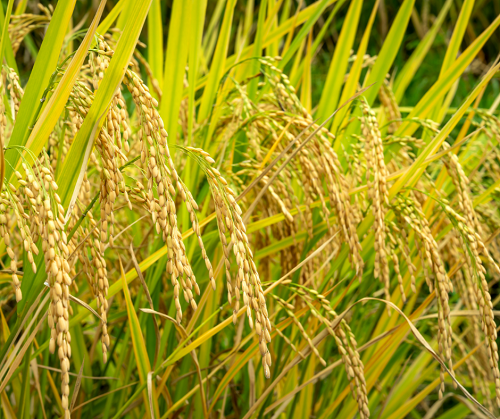
Rice variety-Patkai, Prachur, Shatabdi
Three high yielding rice varieties viz., Prachur, Shatabdi and Patkai were notified by the CVRC for cultivation in the state of Assam.
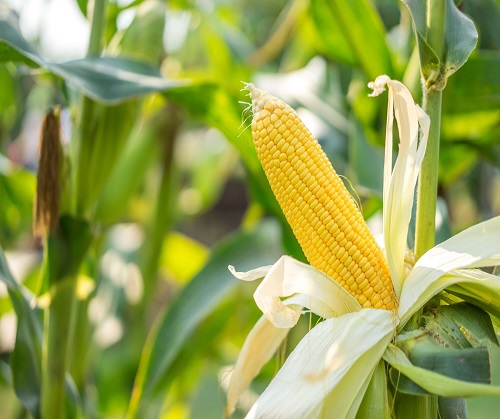
Maize experiment
The experiment on weed management in maize system in rabi recorded the highest grain yield, which has appeared as zonal recommendation in rice maize cropping sequence.
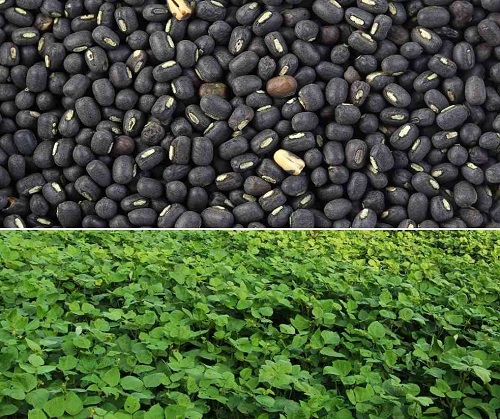
Blackgram variety SBC 50
One newly developed blackgram variety ‘AAU SBC 50’ has completed all the formalities including DNA profiling at NBPGR and ready for submission to SVRC.
Workflow & Monitoring
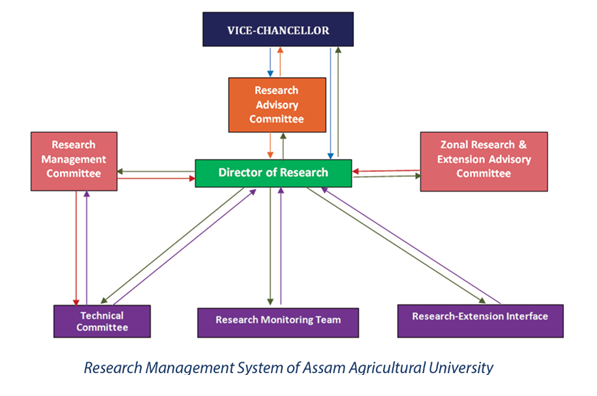
Research Management System
The University follows a well laid out Research Management System to systematically carryout need based, demand driven, situation specific and problem oriented research. Under the current management system (Figure alongside), the research problems are identified based on the information collected by the scientists from the farmers’ fields and also on the basis of the feedback received from the line departments of the state government. The system ensures project based funding and effective monitoring of the programs to make them sharply focused to the relevant problems only.